
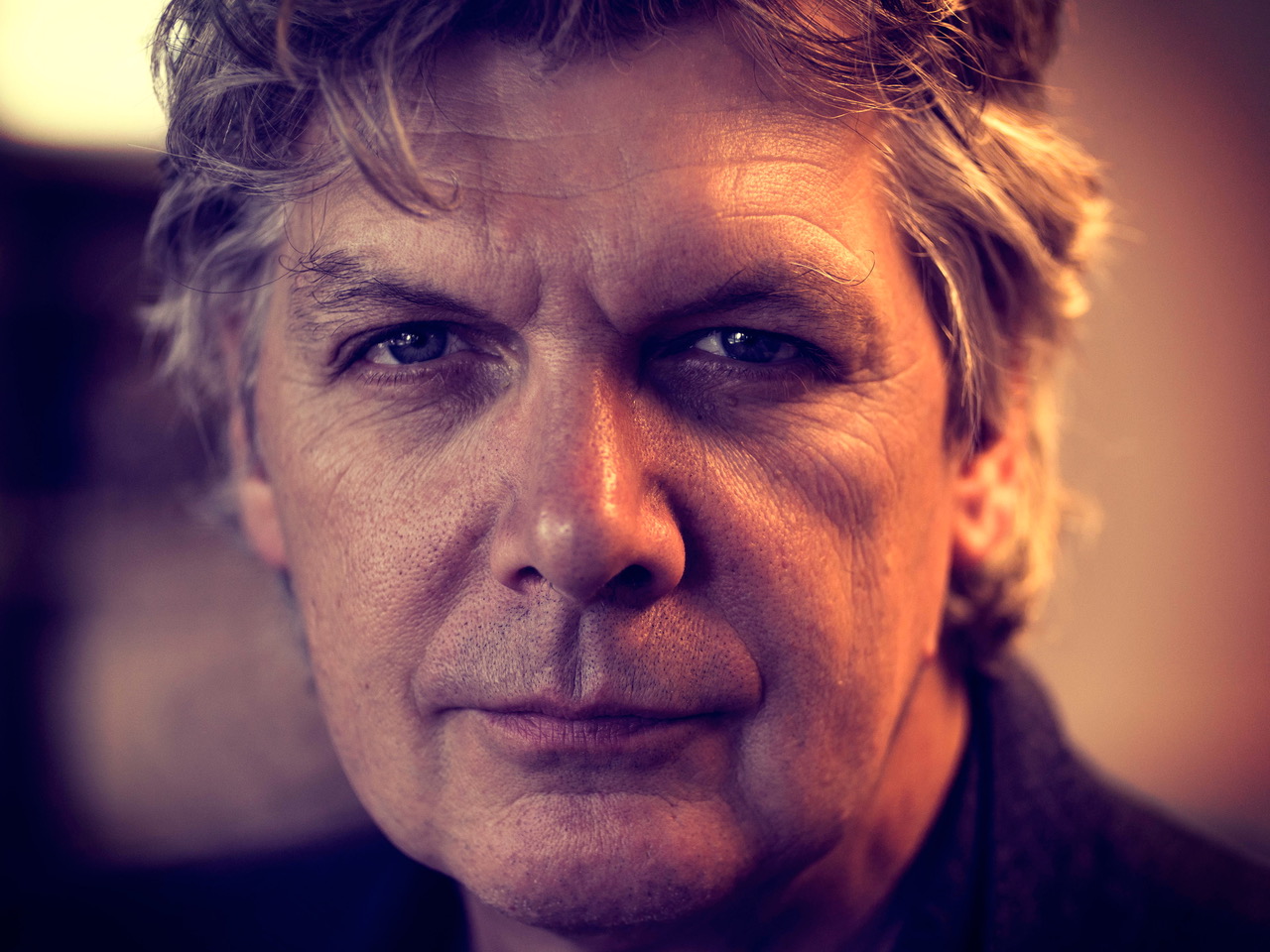
T H E R E I S T I M E – V I N C E N T V A N W A R M E R D A M
Vincent van Warmerdam grew up in a theatre/cinema in IJmuiden, where he was immersed in a world of film, theatre, and music — everything from Tyrolean soft porn to Shakespeare, from operetta to Dutch pop. Although he originally dreamed of becoming a cyclist, it was no surprise that he eventually found himself on stage. At a young age, he achieved national and international success as the guitarist in the legendary Hauser Orkater, alongside his brothers Alex and Marc, Eddie B. Wahr, and Jim van der Woude. One of his first songs was The Beatles in Oud-IJmuiden, from the iconic album Zie de Mannen Vallen.
Through theatre, Vincent entered the world of film music. His score for Abel, the feature film debut of his brother Alex, won the Silver Conductor (Zilveren Lessenaar). For The Northerners (De Noorderlingen), he was named European Film Composer of the Year, and he received a Golden Calf Award for Kicks (by Albert ter Heerdt). He also won a Buma Award for the Argentine film noir Rojo, and the EYE Best Music Award (USA) for the Oscar-nominated Chilean documentary The Mole Agent.
He played in obscure bands like Electric Pleunis, Hit the Pearl, Just Like Eddie, and The Seven Slowhands. His most ambitious band, The Moondogs (with singer Kees Prins), received an Edison Award nomination for their debut album. For Jiskefet, he composed the music for the Ajax football anthem Mijn Club, the No. 2 hit Hé Lullo, heb je nog geneukt?, and the Dutch pop song Suzy by the fictional IJmuiden beat band The Cards.
With Orkater, he contributed concepts and music to a series of musical theatre productions including De Formidabele Yankee, Blackface, and the 19th-century thriller Who Killed Mary Rogers? (winner of the Proscenium Prize). He also created productions about music and musicians: Help! (the early years of The Beatles), Judee Sill (a Californian dreamer), The Prefab Four (The Monkees), and Richard III (featuring music by Tom Waits).
As a guitarist, he was influenced by artists such as The Beatles, Peter Green, John Lee Hooker, Jim Messina, and Richard Thompson. His all-time guitar hero is Ry Cooder, and his mentor Frank Sutherland introduced him to open tunings and fingerpicking. During the pandemic, he released a guitar album: Twango & More Cinematic Guitar Instrumentals.
He has written two novels, De Plectrumfabriek and Boxgeur (published by De Geus), both of which reference the life of a musician in title and content.
There is Time is his debut album as a vocalist. Vincent says the following about the record:
“There is Time is a collection of songs that reveal my love for folk and blues-influenced pop music — indebted to both old and ‘new’ heroes like Brian Wilson, Randy Newman, Gillian Welch, and Blake Mills. Some tracks were written for theatre or film, others ‘just for the sake of it.’ The collection grew over time. Time became not only a recurring theme in the lyrics but also the pressure that forced me to finish the album: it was now or never.
Playing guitar is my foundation, and bringing back the short guitar solo felt natural. But choosing to sing most of the songs myself was a risky move — and yet, there was no other option. I called on the help of friends including Cato van Dijck (My Baby) and Djurre de Haan (AWKWARD i). The formidable Theo Sieben appeared in multiple roles: guitarist, mandolinist, pedal steel player, and vocalist. Having different voices take the lead at times reinforces the idea of an unfolding story with various characters. The plot may be a mystery, but there are plenty of clues to inspire your own interpretation.
The lyrics are more image-driven than anecdotal, with several written by poet Maria Barnas, others by myself, and contributions from Djurre de Haan and Servaes Nelissen. I also borrowed existing texts from Allen Ginsberg, the beat poet, and Dorothy Parker, the wry and witty ambassador of loneliness.
Without the tireless Danny Gras, this album’s production and engineering would have been impossible. The picturesque rehearsal space of De Kift served as the recording location. Marcel Albers and Rose Spearman of M.A.R.S. Worldwide not only invested in resources but also in trust. Friends dropped by — sometimes one by one, sometimes with the whole ensemble. I thank them all:”
-
Dichi Wit – vocals
-
Gerard Atema – piano
-
Mischa Porte – drums
-
Hein Offermans – bass
-
Christan Muiser – drums
-
Patrick Votrian – tuba
-
Rens van der Zalm – violin
-
Arjen de Graaf – viola
-
Joost Buis – lap steel
-
Daniël ‘Dafreez’ Johnson – guitar
-
Kees van der Vooren – vocals
-
Peter van Straten – bass
To quote Oscar Hammerstein II:
“A bell’s not a bell ’til you ring it, a song’s not a song ’til you sing it.”
Vincent van Warmerdam Live:
-
Mischa Porte – drums, vocals
-
Rowan de Vos – piano, vocals
-
Theo Sieben – guitar, mandolin, pedal steel, vocals
-
Hein Offermans – bass, double bass, vocals
DISCOVER EVERYTHING


